
A Strategic-Guide for Multi-Project Success
In today’s rapidly evolving digital environment, IT programs have transcended the notion of being mere collections of standalone projects. They now function as interconnected strategic ecosystems—each initiative contributing to broader organizational goals such as operational efficiency, customer experience, and competitive advantage. Whether the focus is on infrastructure modernization, application deployment, or enterprise-wide digital transformation, the success of any program is fundamentally anchored in one critical discipline: governance.
For IT Program Directors managing complex portfolios—such as overseeing six concurrent projects, each led by its own Project Manager, the need for a robust governance framework is not optional; it is imperative. Effective governance provides the structure and clarity required to align initiatives with strategic priorities, manage interdependence, and ensure consistent delivery standards across the program.
This blog introduces a practical governance model designed to foster strategic alignment, enforce accountability, and enable operational agility. It outlines how clearly defined roles, escalation pathways, and decision-making protocols can streamline execution and mitigate risk. Additionally, we’ll examine how structured reporting rhythms—weekly tactical updates and monthly executive reviews—can enhance transparency, facilitate proactive issue resolution, and empower stakeholders to make timely, informed decisions.
By embedding governance into the fabric of your program, you not only improve delivery outcomes but also build a resilient foundation for scaling innovation. Whether you’re navigating shifting business priorities or responding to emerging risks, governance ensures your program remains coordinated, responsive, and strategically focused
Governance is the backbone of any successful program. It defines how decisions are made, how risks are managed, and how progress is tracked. Without it, even the most well-funded initiatives can spiral into confusion, delays, and missed opportunities.
In a multi-project environment, governance ensures:
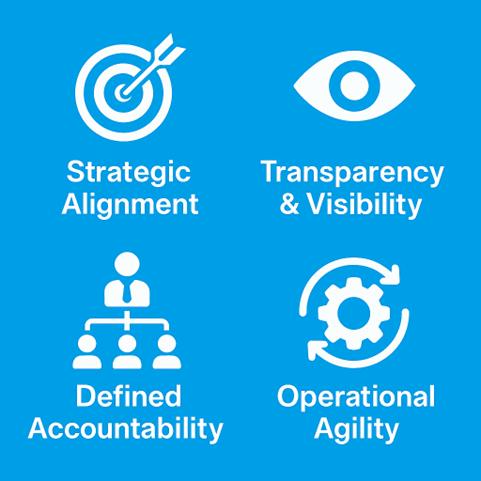
- Strategic alignment across diverse initiatives
- Visibility into progress, risks, and dependencies
- Accountability for outcomes and resource usage
- Agility to respond to change and escalate issues effectively
Governance serves as the foundational framework for any successful program, particularly within complex, multi-project environments. It establishes the mechanisms by which decisions are made, risks are identified and mitigated, and progress is systematically monitored. In the absence of effective governance, even well-funded initiatives are vulnerable to misalignment, inefficiencies, and missed strategic objectives.
In a multi-project context, governance is not merely a support function—it is a strategic enabler. It ensures that all initiatives within the program are aligned with overarching business goals, thereby maximizing the value delivered across the portfolio. By providing a structured approach to oversight, governance facilitates coherence among diverse projects, each with its own scope, stakeholders, and timelines.
Key benefits of a robust governance framework include:
Strategic Alignment
Governance acts as the connective tissue between individual initiatives and the organization’s overarching mission. It ensures that every project, investment, and resource allocation is not just productive—but purposeful.
- Portfolio Prioritization: Leaders can assess initiatives based on ROI, strategic fit, and timing, enabling smarter sequencing and resource deployment.
- Cross-functional Harmony: Governance facilitates alignment across departments, reducing siloed efforts and fostering collaboration toward shared goals.
- Adaptive Strategy Execution: As business priorities evolve, governance provides the structure to recalibrate projects without losing momentum or strategic coherence.
Transparency & Visibility
Governance transforms ambiguity into clarity by embedding standardized tools, dashboards, and communication protocols.
- Real-time Insights: Stakeholders gain access to up-to-date performance data, risk indicators, and milestone tracking, reducing surprises and delays.
- Risk Anticipation: Early detection of bottlenecks or dependencies allows for timely interventions, minimizing downstream impact.
- Stakeholder Confidence: Transparent reporting builds trust across leadership, delivery teams, and external partners, reinforcing accountability and credibility.
Defined Accountability
Clear governance frameworks eliminate confusion around who owns what, ensuring that responsibilities are not just assigned—but embraced.
- Role Clarity: From executive sponsors to delivery leads, each participant understands their scope, authority, and decision rights.
- Performance Ownership: Individuals and teams are empowered to deliver outcomes, not just outputs, with mechanisms for feedback and escalation.
- Compliance & Control: Governance enforces adherence to standards, policies, and quality benchmarks, reducing risk and enhancing consistency.
Operational Agility
In fast-moving environments, governance isn’t a constraint—it’s a catalyst for responsive, coordinated action.
- Scenario Planning: Governance enables teams to model contingencies and pivot strategies without compromising control.
- Rapid Escalation: Defined pathways for issue escalation and decision-making reduce lag time and empower frontline responsiveness.
- Innovation Enablement: By balancing structure with flexibility, governance creates space for experimentation while maintaining strategic guardrails.
Ultimately, governance transforms complexity into clarity. It empowers program leaders to manage risk, optimize performance, and deliver results with confidence. For organizations operating in fast-paced, innovation-driven sectors, investing in a strong governance model is not optional, it is essential for sustained success and strategic growth.
The Governance Structure: Who Reports to Whom
Let’s start with the hierarchy. In this framework, each of the six projects are managed by a dedicated Project Manager. These PMs report directly to the Program Manager, who serves as the central orchestrator of the program. Above the Program Manager sits the Steering Committee and Program Sponsor, who provide executive oversight and strategic direction.
Here’s a simplified view of the structure:
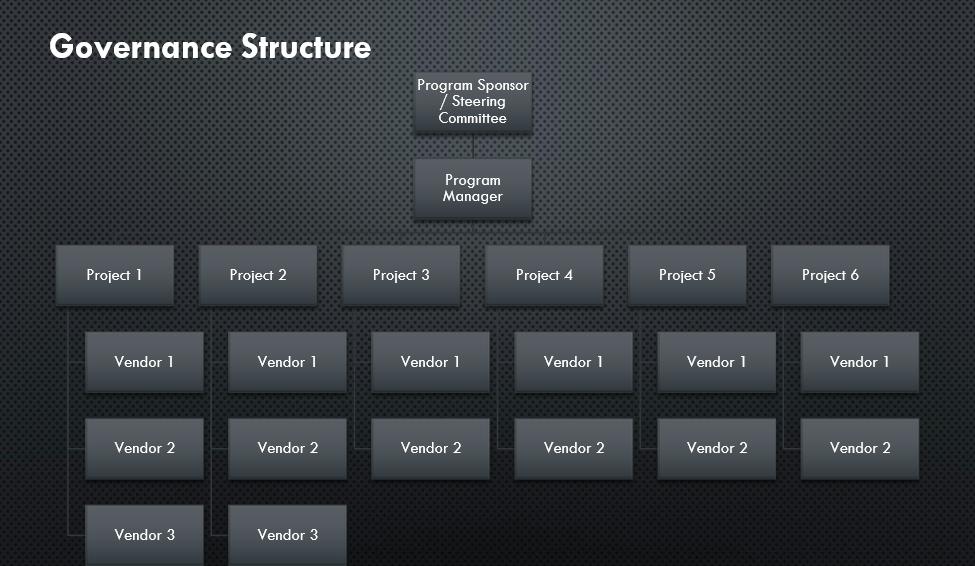
This structure ensures that each project has a clear line of accountability while enabling the Program Manager to maintain a holistic view of the program.
Roles and Responsibilities: Establishing Clarity for Program Success
In any multi-project program, clearly defined roles and responsibilities are essential to maintaining strategic alignment, operational efficiency, and timely delivery. When responsibilities are ambiguous or overlapping, decision-making slows, accountability weakens, and risks escalate. A well-structured governance model begins with role clarity—ensuring that every stakeholder understands their mandate, scope of influence, and communication pathways.
Program Manager: Strategic Integrator and Governance Lead
The Program Manager plays a pivotal role in orchestrating the overall program. Acting as a strategic integrator, they ensure that all projects within the program are aligned with the organization’s broader business objectives. This includes translating strategic goals into actionable program plans and ensuring that each initiative contributes meaningfully to those outcomes.
Key responsibilities include:
- Strategic Alignment: Ensuring that all projects support the overarching business strategy and deliver measurable value.
- Dependency Management: Identifying and managing interdependencies across projects to prevent bottlenecks and ensure coordinated execution.
- Risk Escalation and Reporting: Consolidating project-level reports, synthesizing program-wide insights, and escalating critical risks to the Steering Committee.
- Stakeholder Communication: Serving as the primary liaison between project teams and executive leadership, facilitating transparent and timely communication.
Project Managers: Tactical Executors and Delivery Owners
Project Managers are responsible for the successful execution of individual projects within the program. Their focus is on delivering defined outcomes within agreed scope, budget, and timelines. They serve as the operational leads, translating program objectives into detailed project plans and managing day-to-day execution.
Core responsibilities include:
- Plan Execution: Developing and executing project plans that align with program goals and stakeholder expectations.
- Scope, Budget, and Timeline Management: Monitoring and controlling project parameters to ensure delivery within constraints.
- Risk Identification and Reporting: Proactively identifying risks, blockers, and deviations, and reporting them to the Program Manager for resolution or escalation.
- Status Updates: Providing structured weekly updates on progress, issues, and milestones to maintain visibility and accountability.
Steering Committee: Strategic Oversight and Decision Authority
The Steering Committee provides executive oversight and strategic direction for the program. Composed of senior stakeholders, this body ensures that the program remains aligned with organizational priorities and has the necessary resources and authority to succeed.
Primary responsibilities include:
- Program Health Review: Conducting monthly reviews of program performance, risk posture, and alignment with strategic goals.
- Decision-Making on Escalations: Addressing escalated issues that require executive intervention, including resource conflicts, priority shifts, or risk mitigation.
- Scope and Funding Approvals: Evaluating and approving changes to project scope, budget allocations, or timelines that impact program-level outcomes.
Weekly Reporting: Keeping the Pulse
Weekly reporting is the heartbeat of the governance framework. Every Friday, each Project Manager submits a standardized status report to the Program Manager. This report includes:
- Current status (RAG: Red, Amber, Green)
- Key accomplishments
- Upcoming milestones
- Risks and issues
- Resource updates
These reports are compiled into a dashboard that allows the Program Manager to spot trends, identify bottlenecks, and prepare for cross-project syncs. It’s not just about tracking—it’s about enabling proactive management.
Monthly Reporting: Strategic Oversight
At the end of each month, the Program Manager prepares a consolidated Program Health Report for the Steering Committee. This report includes:
- Summary of each project’s status
- Budget vs. actual spend
- Risk register and mitigation plans
- Strategic alignment updates
- Recommendations for decisions or escalations
The monthly review meeting is where strategic decisions are made—whether it’s reallocating resources, adjusting timelines, or resolving high-impact risks. It’s the moment where governance meets executive action.
Governance Cadence: A Rhythm That Works
Establishing a predictable cadence helps everyone stay aligned. Here’s a sample monthly rhythm:
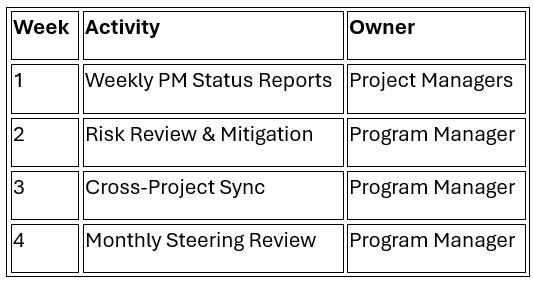
This rhythm ensures that reporting isn’t just a formality, it’s a strategic tool for decision-making.
Tools & Templates: Enabling Governance
Governance thrives when supported by the right tools. Here’s what we recommend:
- Project Dashboards: Jira, MS Project
- Reporting Templates: Excel, PowerPoint
- Collaboration Platforms: Microsoft Teams, SharePoint
- Documentation Repositories: Confluence, OneNote
Standardized templates and centralized tools reduce friction and ensure consistency across projects.
Escalation Path: Managing Risks Effectively
Not all issues can be resolved at the project level. That’s why a clear escalation path is vital:
- Level 1: Project Manager → Program Manager
- Level 2: Program Manager → Steering Committee
- Level 3: Steering Committee → Program Sponsor
This structure ensures that risks are addressed at the right level, with the right urgency.
Success Metrics: Measuring What Matters
Governance isn’t just about structure, it’s about outcomes. Here are the metrics that define success:
- On-time delivery across all projects
- Budget adherence
- Stakeholder satisfaction
- Risk containment
- Strategic value realization
Tracking these metrics ensures that governance drives real business impact.
Final Thoughts: Governance as a Strategic Enabler
In a world where IT programs are increasingly complex and high-stakes, governance isn’t a bureaucratic burden, it’s a strategic enabler. By establishing clear roles, predictable rhythms, and effective reporting structures, you empower your teams to deliver with confidence and clarity.
Whether you’re managing six projects or sixty, the principles remain the same: transparency, accountability, and alignment. With the right governance framework, your program won’t just survive—it will thrive.