We have all seen it happen.
Your notification icon lights up. You open LinkedIn expecting a insightful comment on your latest industry post, only to find a direct message from a former colleague you haven’t spoken to since 2018:
“Hey! Hope you’re doing well. Quick question—are you still connected to the VP of Engineering at [Company]? I saw they have an opening and was wondering if you could introduce us?”
It feels transactional, slightly uncomfortable, and entirely predictable.
Over the past decade, professional networking has undergone a massive expansion in quantity, but a dramatic decline in quality. We have created “Zombie Networks”—vast, sprawling lists of hundreds or thousands of connections that exist in a state of suspended animation. They are neither truly dead nor genuinely alive. We collect connections like digital trophies, yet we only disturb their sleep when we need a job referral, a sales pitch, or a favor.
To build a resilient, meaningful professional ecosystem, we must move away from transactional outreach. An effective network isn’t built in times of crisis; it is sustained through genuine, periodic check-ins when you need nothing in return.
1. The Anatomy of a Zombie Network
What exactly is a Zombie Network?
It is the direct result of modern “growth hacking” mindsets applied to human relationships. In the early days of platform networking, connection requests meant something. Today, automated connection tools, quick “One-Click Add” features, and aggressive outreach strategies have inflated our contact lists beyond human capacity.
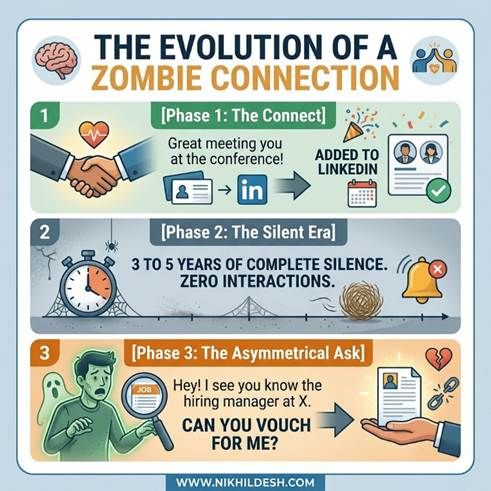
When a network consists purely of passive profiles you haven’t engaged with in years, two things happen:
- Trust Evaporates: Trust degrades over time without contact. An ask made after years of silence feels opportunistic.
- Algorithmic Disconnect: Professional platforms curate feeds based on engagement. If you never interact with your connections, you lose visibility into their professional shifts, milestones, and challenges.
2. What Psychological Research Says About Networking
The discomfort we feel when reaching out only when we need something isn’t just in our heads—it is deeply rooted in human psychology and behavioral science.
The Instrumental Dilemma & “Feeling Dirty”
A landmark study led by researchers at Harvard Business School, Northwestern University (Kellogg), and the University of Toronto (Casciaro, Gino, & Kouchaki, 2014) examined the psychological effects of professional networking.
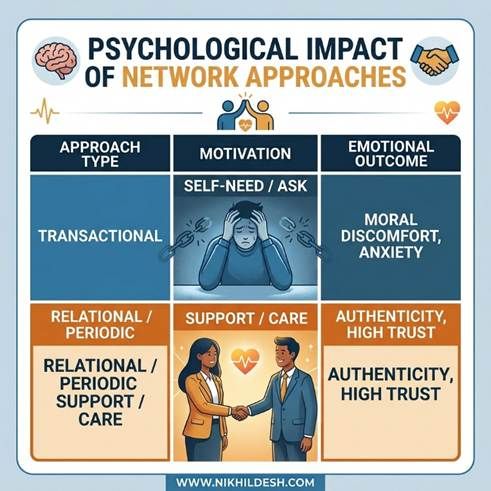
The researchers discovered that professional networking—when driven purely by instrumental (use-oriented) motives—makes individuals feel physically and morally “dirty.” The study revealed that people perceive purely transactional networking as a threat to their moral purity, leading to a subconscious aversion to reaching out altogether.
Key Finding: Instrumental networking without personal connection triggers psychological discomfort. Conversely, networking built on spontaneous, non-transactional support yields higher self-worth and better professional performance.
The Power of Dormant Ties
We often assume our closest connections (strong ties) are our most valuable professional assets. However, foundational research by Stanford Professor Mark Granovetter (“The Strength of Weak Ties”) and subsequent research on “Dormant Ties” by Dr. Daniel Levin (Rutgers University) and colleagues (Levin, Walter, & Murnighan, 2011) challenge this assumption.
Levin’s research studied executives who reconnected with “dormant ties”—people they had lost touch with for three or more years. The findings were striking:
- Better Insights: Dormant ties offered far more novel and valuable insights than active close connections because they had been exposed to different environments, ideas, and networks during the gap.
- Rapid Re-engendered Trust: If a foundation of goodwill existed previously, trust could be restored rapidly through a simple, non-transactional touchpoint.
However, the key catch is that reconnecting is significantly easier and yields better outcomes if the connection hasn’t been completely neglected until an emergency arises.
3. Why Transactional Networking Backfires
When you treat your network like a vending machine—inserting a message only when you expect a favor to pop out—you incur subtle but serious career costs:
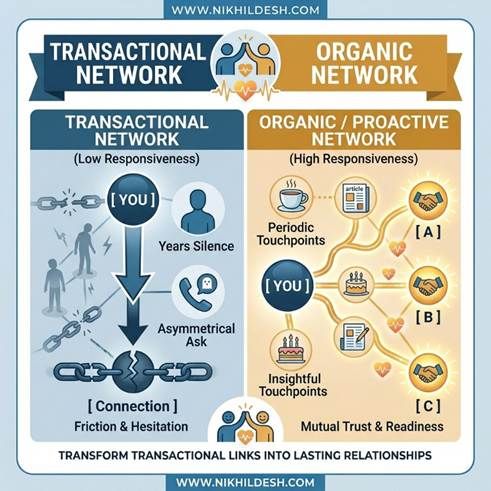
- High Friction: When you reach out cold after years, the receiver must evaluate whether helping you is worth their time and social capital.
- Reputational Tax: People notice patterns. If your name only appears in DMs during career transitions, you gain a reputation as a mercenary networker.
- Missed Opportunities: The best professional opportunities—advisory roles, early-stage partnerships, unlisted positions—happen organically through casual conversations, long before a formal need arises.
4. The Anatomy of a Effective “No-Ask” Check-In
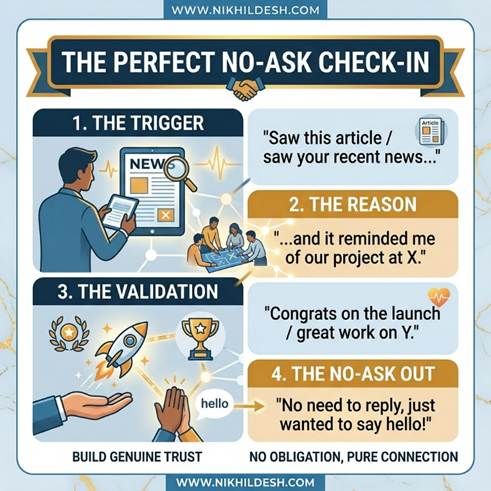
How do you keep a network healthy without spending hours every day drafting emails? The secret lies in low-frequency, high-authenticity touchpoints
An effective periodic check-in requires three components:
- Zero Ask: Do not include a hidden favor or request.
- Contextual Relevance: Mention something specific to their work, an interest they share, or a shared memory.
- Low Pressure: Give them an easy out so they don’t feel obligated to write a lengthy response.
Framework for a Periodic Pulse Check
Real-World Examples
Scenario A: Congratulating a Shift
“Hi [Name], saw that your team launched the new product feature last week. Looks like a massive milestone after all the work you put in! Hope you’re getting a chance to celebrate. No reply needed—just wanted to send some quick congrats!”
Scenario B: Sharing Knowledge
“Hey [Name], came across this report on cloud migration architecture today and immediately thought of our conversation last year. Hope all is well with you and the team!”
Scenario C: Simple Time-Based Outreach
“Hi [Name], hard to believe it’s been two years since we worked together on the infrastructure rollout. Was thinking about our team the other day and wanted to see how you’re doing. Hope all is well!”
5. Implementing a Sustainable Cadence
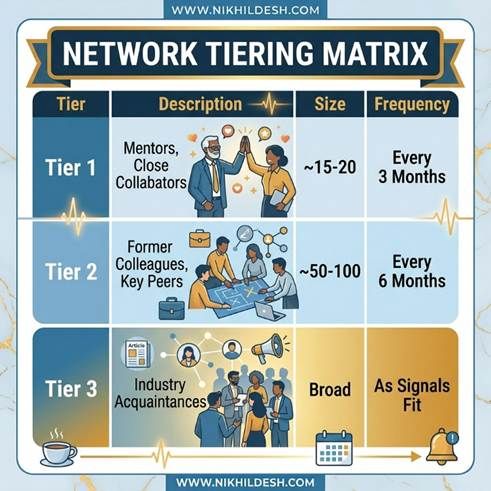
To avoid burnout, you don’t need to message every connection every month. Instead, segment your network into actionable tiers.
A 10-Minute Weekly Routine
- Monday: Scroll through your feed and leave 3 thoughtful, substantive comments on connections’ posts (avoid basic “Congrats!” comments).
- Wednesday: Identify 2 people from your Tier 2 list you haven’t spoken to in over 6 months. Send a quick, no-ask message.
- Friday: Review any career updates or company news in your network and send a personalized note to 1 person celebrating their milestone.
Summary & Key Takeaways
A professional network is a living ecosystem, not a database of contacts to be mined when convenient.
- The Zombie Network Hazard: Collecting silent connections creates transactional friction and makes outreach uncomfortable.
- Psychological Reality: Research shows that purely instrumental networking causes psychological discomfort, while proactive, relationship-based outreach builds trust and unlocks the hidden value of “dormant ties.”
- The No-Ask Strategy: The most powerful check-in asks for nothing, offers value or validation, and relieves the recipient of obligation.
- Consistency Over Intensity: Small, structured weekly habits keep your network warm and engaged long before you ever face a career transition or business need.
A Question for You
Take a look at your recent LinkedIn messages. When was the last time you reached out to a connection purely to check in, offer value, or say thank you—without asking for a single thing in return?