
As of March 3, 2026, the world has witnessed a tectonic shift in geopolitics. The joint US and Israeli strikes on Iran, carried out on February 28, and the assassination of the Supreme Leader have transformed this from a “cold” proxy war to a “hot” regional conflict. As someone who has spent 25 years navigating the nexus of economics and geopolitics, I understand this not merely as a military engagement but a full-scale recalibration of the “Petrodollar” and the “Global South” trade routes.
Chapter I – The Impact
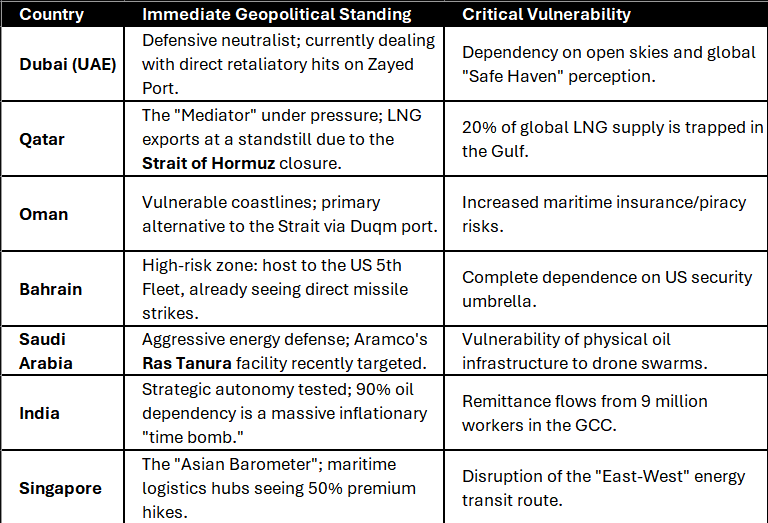
The strategic impact analysis of the specified regions and domains is as follows:
I. Regional Impact Analysis
II. Domain-Specific Deep Dive
1. Energy: The $150/bbl Question
- Hormuz Chokepoint” is no longer a theory; it is a reality. With ~20 million barrels per day (bpd) of oil and 20% of global LNG “effectively” trapped, we are seeing a bifurcated market.
- GCC Impact: Saudi and UAE using pipelines (East West and Fujairah) but only using a fraction of capacity.
- India: Projected to lose 2-3% of GDP if oil prices remain above $100/bbl for over a quarter.
- Singapore: Seeing sharp increases in refinery margins but experiencing declining refinery volumes due to tanker insurance withdrawals.
2. Real Estate: Sentiment vs. Structure
- In Dubai, we’re seeing a “strategic pause” rather than a “fire sale.” Transaction levels have declined by 40% this week.
- The UAE: Seeing a “Millionaire Migration” of 9,800 units in 2025. However, if this conflict extends beyond 3 weeks, we’ll see a price correction of 5-10% in off-plan luxury units.
- India: Surprisingly, Indian real estate may benefit due to “NRI flights” to India for safety.
3. Crypto: The Digital Gold “Failure”?
The geopolitical hedge story for Bitcoin was put to the test on February 28.
- Observation: BTC lost 2% immediately following the attacks, acting like a tech stock rather than gold.
- Impact: A liquidity squeeze in the region, impacting the GCC, has led to a decline in stable coins, with investors moving to physical USD and Gold, reaching $2,600+.
4. Conglomerates: Supply Chain Fragility
- India (Reliance/Adani): These titans are in trouble. Reliance is switching to Russian oil to avoid the Middle East, while Adani’s port business at Mundra is experiencing a surge in war risk surcharges.
- Singapore (Temasek/GIC): Their investments are being directed to “Defence & Food Security” as global supply chains become unreliable.
5. Stock Markets: The Great Re-Pricing
- UAE (DFM/ADX): Markets closed until March 3rd to stop the bleeding. Re-opening will see a 5% gap-down.
- India (Nifty/Sensex): IT services are experiencing a correction following anticipated cuts to discretionary spending from US/EU clients facing high energy bills.
- Saudi (TASI): Petrochemicals are performing well, but banking and insurance stocks are experiencing significant losses.
6. Defence: The New Arms Race
This war has clearly shown that “Surgical Strikes” are a thing of the past, and we have entered the era of Drone & Cyber Attrition.
- GCC Strategy: There has been a massive shift towards integrated missile defense, including THAAD and Patriot, and indigenous drone development.
- India: There has been a faster move towards “Aatmanirbhar” (Self-reliance) in defense so that the disruption in the Middle East does not impact the Indian Air Force’s supply chain
Chapter II – The Opportunities
This is the point where the “wheat is separated from the chaff.” In a high volatility environment caused by a USA-Iran conflict, the traditional “buy and hold” strategy for the Gulf or global tech has a quick death. We are entering a “Fortress & Friction” economy.
As an economist, looking at the world in 2026, this is where the smart money, the best and brightest, and the mobile elite are going.
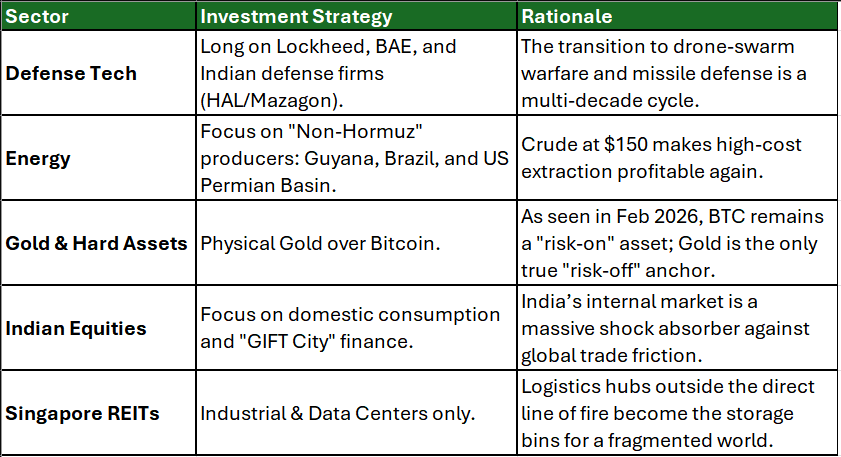
1. Investment Opportunities: The “Anti-Fragile” Portfolio
In this scenario, liquidity is king, and “tangible” is the queen.
2. Career Opportunities: Demand for the “Fixers”
The world does not need more “growth hackers”; we need more Resilience Architects.
- HSIM & Crisis Directors: As we discussed in our earlier sessions, the ability to manage High Severity Incidents in the Banking and Infrastructure sectors is currently the most “recession-proof” skill in the FIS world.
- Supply Chain Re-Engineering: Companies are hiring “Logistics Strategists” that can bypass the Strait of Hormuz and the Red Sea. Experience in “Near Shoring” and “Friend Shoring” is the new MBA.
- Energy Transition Consultants: Every major conglomerate in India and Singapore is currently desperately seeking to de-couple from the oil price volatility. Experience in scaling green hydrogen and/or nuclear is commanding salary premiums of 50%+.
- Cyber Defense & Electronic Warfare: As Iran and the USA exchange blows in the cyber domain, every bank and utility is currently a front-line target.
3. Relocation: The Search for “Geographic Alpha”
If you are carrying a suitcase, here is where you should be looking to unpack:
The “Safe Harbors”
- Singapore: Despite the cost of living, it remains the ultimate neutral ground. It is the “Switzerland of the East” where Western and Eastern capital meet when the Middle East is too hot to handle.
- India (GIFT City & Bangalore): For NRIs in the GCC, the “flight to home” is no longer just an emotional play. It is a tactical one, as GIFT City provides the ease of doing business of Dubai and the safety of the Indian mainland.
- Oman (Salalah/Duqm): If you are to stay in the Gulf, stay south of the Strait. The energy ports of Oman that face the Indian Ocean are the only viable exit strategies left in a Hormuz closure scenario.
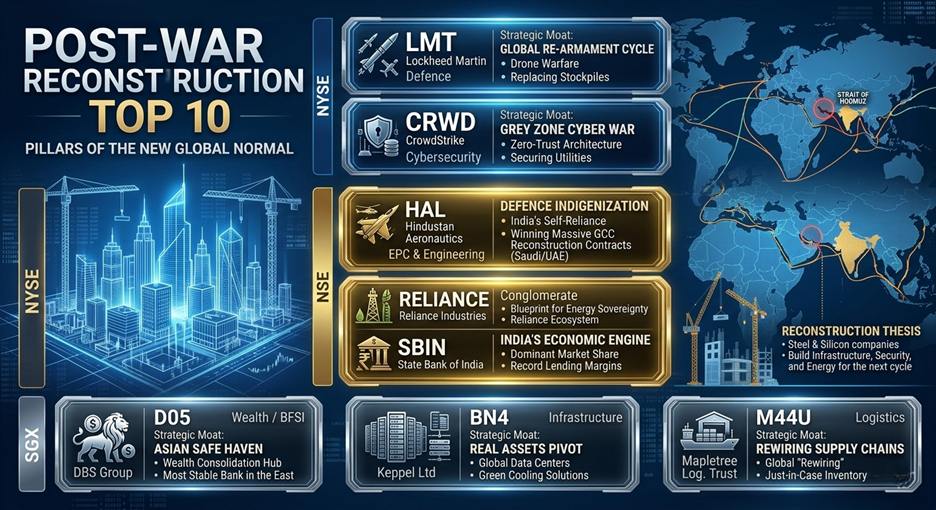
Recommended Top 10 stocks post war era are as follows:
Chapter III – The Conclusion
The effect of war calls for a shift from growth-centric optimism to a “Fortress and Friction” state of mind. One must understand the impact followed by adjustments in investments, career plan, relocation & learning. The corrections will prepare for post war era and new opportunities to seize.
War is destructive, yet it remains an unavoidable feature of the global order.